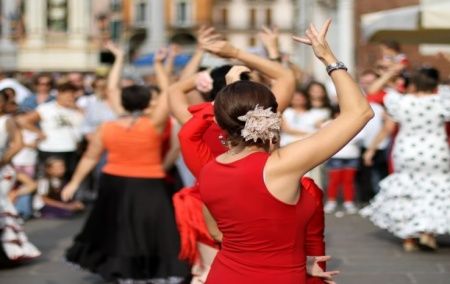
Recent research has revealed that Almeria was fundamental to the development of flamenco in the mid-19th century. However, until now, this province has not received the sufficient recognition that it deserves in this respect.
Despite the fact that writers and renowned historians from all over the world came to the province of Almeria, attracted by the cultural manifestations that were emerging at that time, they completely forgot what the Almerian artists were developing and that, afterwards, it was taking off worldwide.
Spanish passion
Flamenco is an art that involves singing and dancing, and dates back to the 18th century. Although many agree that it was born in Andalusia itself, its origin is not yet clear.
The truth is that flamenco fever in Almeria became stronger after the appearance of the so-called “cafes cantantes”, and the passion for this style has been so great that nowadays it is a cultural manifestation that prevails in the tastes of the population.
In July 1966 the first Flamenco Festival was created in Andalusia. In 2016, it fulfilled its golden wedding, which was celebrated in a big way with concerts, talks, guided visits, cinema, exhibitions and master classes. These were activities that for the first time in the region's history, were not carried out within the framework of the Feria of Almeria.
At this event, artists including Rocio Segura, Tomas de Maria, Niño Josele, Montse Perez, Eva La Yerbabuena, Arcangel and Farruquito participated, among many others, as they were keen to keep this divine expression alive and they gave the best of themselves in all their performances.
According to journalistic investigations, one can infer some historical reasons why Almeria could be, in some way, the cradle of flamenco.
One of these historical events is the creation of the “cafes cantantes” between 1820 and 1920, where artistes performed their songs and dances. It was they who transmitted the passion for flamenco throughout Spain.
Others attribute the trend to the workers of the “boarding grapes”, a hard skinned and very resistant grape variety, which was crucial to the economy of Almeria, when the boats did not have large engines for long trips. This grape was able to withstand long journeys by sea without losing its freshness, and it was much in demand by English, Germans and Americans in those times. While they were working, the field workers in Almeria sang their famous “fandangos”.
Flamenco styles
1. The “Fandango”.
According to historical data, it dates from the 18th century in Andalusia. It is a dance accompanied by singing. It originated in the 19th century and, as it has developed, it has acquired several variants.
In Almeria, different types arose such as the “Fandango de Cuevas”, the “Fandango de Nijar”, the “Fandango de Laujar” and the “Fandango of the Los Velez region”, among others.
2.- The “Taranta”.
It is a flamenco from the province of Almeria. It is a kind of fandango that took shape thanks to interpretations given by the mine workers. While they worked, they sang as a way to alleviate the suffering left by each hard working day.
The difference between the “fandango” and the “taranta” is that the second stopped being so rhythmic, but became deeper.
Between 1820 and 1860, artistes of the time, after listening to the men sing, took some pieces and gave them various forms. Pedro El Morato and Juan Martin "El Cabogatero" were some of the most famous interpreters of the “taranta”.
3. The “Taranto”.
“Taranto” is a kind of flamenco also from the province of Almeria. It derives from the “taranta” and it is said that the term was coined by the dancer Carmen Amaya and the guitarist Sabicas in the year 1940.
The first to record “tarantos” were Manuel Torre and El Cojo de Malaga, but then it was not known by that term at the time. His name became widespread when the cantaor Fosforito claimed the taranto in 1956, at the National Flamenco Contest in Cordoba.
4. The “Peteneras”.
It is not known for sure what its origin is. Some say it comes from Paterna del Rio in Almeria, and others say it is from Paterna de Rivera in Cadiz.
However, the hypothesis is that this style developed in Cuba after Almeria's emigrants moved to the Caribbean island in great numbers, and infused much of their culture there.
By 1880 it was a cante in full swing in Sevilla; however, this style had already been established in Almeria much earlier.
Activities in the province of Almeria
The best Tours & Activities in the province of Almeria